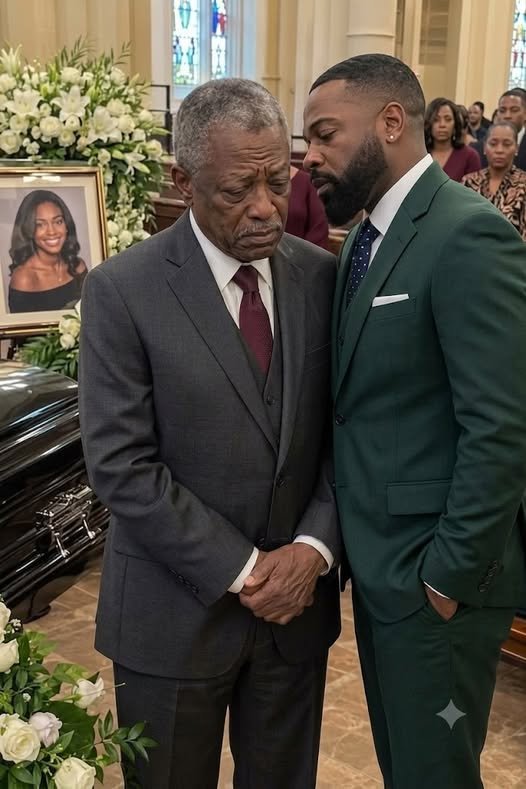
At My Daughter’s Funeral, My Son-in-Law Stepped Close and Whispered, “You Have Twenty-Four Hours to Leave My House”
The cemetery was silent except for the soft rustle of autumn leaves and the muffled sobs of family and friends gathered beneath gray skies. A cold breeze swept across the rows of headstones as everyone stood around my daughter’s freshly lowered casket. White lilies covered the grave—her favorite flowers. She had always said they reminded her of hope.
Hope.
Standing there, dressed in black, I couldn’t remember what that word even felt like.
Losing my daughter, Emily, at just thirty-six years old wasn’t something any parent should ever have to endure. Just two weeks earlier, she’d been laughing on the phone, telling me about the pumpkin pie she planned to bake for Thanksgiving. Then, without warning, a brain aneurysm stole her from us.
One moment she was here.
The next, she was gone.
My knees felt weak as the pastor finished his final prayer.
People approached one by one, hugging me, offering condolences that blurred together into meaningless phrases.
“She’s in a better place.”
“She isn’t suffering anymore.”
“Stay strong.”
None of it eased the unbearable emptiness.
Then came my son-in-law.
Daniel.
He walked toward me with a face completely drained of emotion. His expensive black suit looked perfectly pressed. His eyes were dry.
Too dry.
Instead of embracing me, he leaned close enough that only I could hear him.
“You have twenty-four hours to leave my house.”
For a second I thought grief had distorted my hearing.
“What?”
“You heard me,” he whispered coldly. “Tomorrow evening, I don’t want you there.”
Then he stepped back, nodded politely for the benefit of everyone watching, and walked away as though he’d offered comforting words.
I stood frozen.
My hands began trembling.
Not because of the threat itself…
But because the house he was talking about wasn’t his.
It had belonged to my daughter.
Or at least…
That’s what I had always believed.
Three years earlier, after my husband passed away, Emily insisted I move in with her and Daniel.
“You shouldn’t be alone anymore, Mom,” she’d said, squeezing my hand. “We’ll take care of each other.”
At first, I refused.
I didn’t want to feel like a burden.
But Emily wouldn’t take no for an answer.
She converted the downstairs guest suite into a cozy apartment just for me. We drank coffee together every morning before she left for work. We watched old movies on Friday nights and baked together every Sunday.
Those became the happiest years I’d had since losing my husband.
Daniel was polite enough in the beginning.
Quiet.
Reserved.
Always working.
But after Emily died, something changed.
Within hours of returning from the hospital, he started locking himself in his office.
He barely spoke.
Barely looked at me.
I assumed grief had simply consumed him.
Until the funeral.
Until those whispered words.
That evening, I sat in my room surrounded by framed family photographs, wondering where I was supposed to go.
I had no savings.
My pension barely covered medications.
The house had become my home.
I cried myself to sleep.
The next morning I began packing.
Halfway through folding my clothes, someone knocked on my bedroom door.
It was my granddaughter, sixteen-year-old Sophie.
Her eyes were swollen from crying.
“Grandma…”
I forced a smile.
“Good morning, sweetheart.”
She looked at the open suitcase.
“Why are you packing?”
I hesitated.
Finally, I told her the truth.
“Your father wants me to leave.”
She stared at me.
“What?”
“He gave me until tonight.”
Her face turned pale.
“No.”
“I’m afraid so.”
She shook her head.
“He can’t.”
I sighed.
“It isn’t my decision.”
Sophie ran upstairs without another word.
Seconds later I heard shouting.
Real shouting.
For the first time in years.
“You said WHAT to Grandma?”
Daniel’s voice answered, muffled through the ceiling.
Then came another yell.
“That’s not even your house!”
My heart skipped.
Not your house?
Moments later Sophie burst back into my room holding a large envelope.
“I think Mom wanted you to have this if anything ever happened.”
Inside was a handwritten letter.
My hands trembled as I unfolded it.
The date at the top showed it had been written eight months earlier.
“Mom,” it began.
“If you’re reading this, something happened to me.”
My vision blurred.
“I know Daniel loves us, but lately he’s been making decisions that worry me. If I’m not here anymore, I need you to know the truth.”
There was another document beneath the letter.
A copy of the property deed.
My name.
Emily’s name.
Joint owners.
I looked at Sophie in disbelief.
“I don’t understand.”
She smiled sadly.
“Mom told me she added your name after Grandpa died. She said no one would ever be able to force you out.”
Tears streamed down my face.
Emily had protected me.
Even after she was gone.
That evening Daniel returned home carrying several cardboard boxes.
He stopped when he saw me calmly drinking tea in the living room.
“I thought I told you to leave.”
“I remember.”
“So why are you still here?”
Without saying a word, I slid the property deed across the coffee table.
He picked it up.
Read it once.
Then again.
His face turned ghostly white.
“What is this?”
“The truth.”
He looked at me in disbelief.
“This can’t be real.”
“It is.”
He sank into a chair.
For several minutes neither of us spoke.
Finally he whispered,
“She never told me.”
“I believe that.”
He rubbed his face.
“I’ve been angry.”
“I know.”
“I thought everyone expected me to carry everything alone.”
His voice cracked for the first time since Emily died.
“I didn’t know what to do.”
Neither did I.
Grief had turned us into strangers living under the same roof.
Instead of grieving together…
We had been grieving alone.
“I’m not your enemy, Daniel,” I said quietly.
“I never was.”
He looked at the family photos lining the fireplace.
Then tears finally came.
Real tears.
“I miss her.”
“So do I.”
We cried together that night.
Not as rivals.
Not as opponents.
But as two broken people who had loved the same remarkable woman.
Months later, we decided not to sell the house.
Instead, we honored Emily the way she would have wanted.
Every Sunday, Sophie and I baked her favorite pumpkin pie.
Daniel joined us.
Sometimes we laughed.
Sometimes we cried.
Always, we remembered.
Because love doesn’t end at a funeral.
It lives on in shared meals, family traditions, quiet forgiveness, and the courage to choose compassion over bitterness.
Emily was gone, but the home she built with love remained exactly what she always wanted it to be—a place where family stayed together, even after heartbreak.